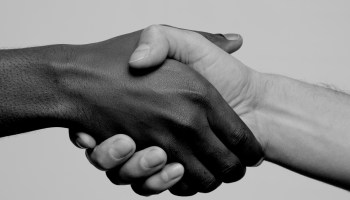
Pre-Prologue…
This post was started in 2018 when the country was in turmoil and rioting against police brutality following a string of beatings and killings of black people by police. I did not have the courage to complete or post it at the time. But its 2020 and the problem has continued. My faith and conscious will no longer allow me to be complicit with my silence and I feel compelled to speak out in my small circle of influence. So at the risk of offending good friends and family whom I know will disagree vehemently , I respectfully speak from my heart. I am in no way condemning anyone in general, including police officers. I personally know officers who feel just as badly about this situation as I do and who do their best within the system. But the system needs to change. And not just the police system, but the media, education, healthcare, corporate America, the criminal justice system, the political system and the church all need to examine the inherent racism that infects their policies, protocols and rhetoric whether conservative or progressive. It is time for some major self-reflection and action. I am not defending violence or vandalism whether in Minneapolis in 2020 or Boston in 1770. But if you find yourself judging the protesters, check to make sure you are just as incensed by the unpunished murders they are protesting as you are about their protests. Try to understand the hurt and injustice causing their response. Instead of offering advice or teaching, try listening to their side of history. Although Martin Luther King did not condone or approve of riots, he understood them. “Riots are the language of the unheard.” -MLK
Prologue…
In my last post I skirted around the issue of race, and alluded to the fact that I would tackle it in a future post. This is my first and probably not my last attempt. I pray that you read it with an open heart and mind. And if you find yourself uninterested in or irritated by the topic of this post, then I dare say with the utmost respectfulness and sincerity that it may be written just for you, so hang in there, take a deep breath and hear me out.
Because this is a sensitive and complex issue, I will address it over two posts (possibly more). The first will address the concepts of race and racism because a basic understanding and acknowledgement of their existence is the first and therefore most important step in dealing with these issues. The second post will build on these concepts and further discuss alternatives, connecting them to Christianity and parenting.
So what does race have to do with raising red letter kids?”, you might ask, and why would I write about such a controversial topic, especially when I know it might get me into trouble or offend people I know and care about? First of all, I would respectfully wager that if that question is going through your mind, you are most likely not black and/or not a parent. Black parents (and other parents of black children) don’t have the luxury of not addressing race and racism. For them it is potentially, but literally a matter of life and death. Secondly, raising red letter kids means raising kids who love Jesus enough to take His words seriously and follow His example, living their lives according to those words. That’s it. And one of, if not the most important thing Jesus calls us to do is to love one another like we love ourselves, and not only those who we like, or relate to, “even pagans and tax collectors do that”. Loving others sounds simple, but it’s not always easy. If I am going to model that kind of generous love for others to my kids, in hopes that they love others like Jesus did, then I need to be willing and able to tackle the race issue. After all, no one is born with prejudice, it’s learned, and it’s mostly learned at home.
Disclosures…
Before diving in I must disclose that I am not a social scientist and this will only be a brief and general overview of a very complex topic. I do however plan to lean on experts and the literature to delve in beyond the basic dictionary definitions which are always a good starting point, but definitely not an ending one for issues as multifaceted as racism, especially when they are written by majority white males. (Those who believe Oxford or Webster to be a sufficient and final authority should look up the definition of ketchup, where it is defined as a spicy sauce https://en.oxforddictionaries.com/definition/ketchup ). For those who are looking for a more complete introduction to the topic, I suggest starting with Ken Wytsma’s The Myth of Equality. It is a good entry point for anyone not familiar with racism personally, but will hopefully spark a desire to progress to reading and listening to authors of color who speak from experience.
Also, as a white American, I in no way presume to understand what it is like to be black, Latinx or any other race or ethnicity not in power in this country. My thoughts are mine alone and do not speak for others, especially those who may be more directly affected by these issues than I am. And to any readers who consider themselves people of color, this post is obviously not directed to you specifically, but to readers who are unfamiliar and/or uncomfortable with the topic. I am speaking to my circle of influence and from my heart and world view. I realize that my viewpoints as a white woman are biased, incomplete and potentially racist and offensive at times. For that I humbly apologize and request your honest feedback. I will do my best to decenter myself and keep your experience central.
Concepts defined…
Additionally, I am using race and ethnicity interchangeably at times only in the context of racism and because they are used that way by the perpetrators of discrimination. The UN declares there is effectively no difference between racial discrimination and ethnic discrimination. Although ethnicity technically has a less nuanced definition of belonging to a social group that has a common national or cultural tradition. Whereas race has to do with one’s physical and social characteristics and is much more complicated.
I’m sure some may question my focus on race at all, stating that discrimination happens independently from race or ethnicity. A common response to the topic of racism today is, “what about the Appalachian poor?” The Netflix movie Mudbound, a historical fiction, does an excellent job of dealing with issues of poverty and race. While it is true that people of all different colors are discriminated against based on gender, sexual orientation, class, socioeconomic status, and education level, it is also true that not all types of discrimination are equal. And whatever burden those other groups carry is exponentially heavier if they are also black. To be gay is to know discrimination, but to be gay and black is to know nothing else. To be a woman in a traditionally male workplace can be difficult, but to be a black woman it can be an impossibility.
While I am definitely not suggesting a discrimination contest to compare who has the worst situation as a helpful solution to the problem. What I am saying is that race is a unique motivator of prejudice and persecution. Many people don’t realize that the concept of race is a recent and socially constructed concept, which has no scientific basis. https://www.scientificamerican.com/article/race-is-a-social-construct-scientists-argue/ Scientists who study DNA and human genetics will tell you that there is more diversity among a group of Swedes and a group of Zambians than between the two groups.
The term race as it is used today can be traced back to the Atlantic slave trade and the colonization of the Americas and was ultimately an invention of economic and political necessity for those in power, who were already racist in their worldview. To quote Ta-Nehesi Coates from his book Between the World and Me, “But race is the child of racism, not the father. And the process of naming “the people” has never been a matter of genealogy and physiognomy so much as one of hierarchy. Difference in hue and hair is old. But the belief in the preeminence of hue and hair, the notion that these factors can correctly organize a society and that they signify deeper attributes, which are indelible—this is the new idea…”
Race was and is used to create an artificial hierarchy of human worth based mainly on phenotype, generally three main physical attributes as variables ranging from less to more: the amount of melanin in one’s skin, the width of one’s nose and/or lips, and the texture of one’s hair from straight to curly. This gradient of attributes has an inverse relationship to the value of the person exhibiting them, where the further along the gradient one appears (and the further from the northern European phenotype one appears), the less value the person is worth, to the point of one’s humanity being subtly questioned or blatantly denied. When it comes down to the socially engineered totem poles of human worth and discrimination, blacks find themselves at the bottom of the former and top of the latter. So yes, all lives do matter, but unfortunately, in most of society they do not all matter as much.
Now just because race is a social construct and not a biologic one, does not mean it is irrelevant. Race and its hierarchy of human worth have been foundational issues for this country (and its economy) since its birth, and continue to be at the root of many of our society’s problems. One reason is that with that gradient of human worth comes power, specifically power to create and enforce policies that perpetuate privilege in one group and/or persecution or prejudice in another. My quasi-anthropologist hubby tells me it’s called hegemony, dominance by one social group over another. This is why racism as it is practiced today is often defined by sociologists as prejudice plus power. And although Ibram X. Kendi would disagree, this is also why reverse racism is generally thought to be an oxymoron.
Now before you attack your keyboard responding to that last statement, let me further dissect the definition of racism. The word racism is made up of “race” which we have previously discussed, and –ism which denotes a system. So, while it is possible to be a racist on an individual level, the effect of one’s thoughts, words and actions is different depending on the larger group one is representing. Racism cannot occur unless one’s group in society holds the majority of power and privilege. Those in the group with power being prejudice toward another social group, contributes to the systemic problem of racism. In fact, just benefiting from that systemic power gradient indicts oneself in the problem of racism. Historically and presently the privilege/power gradient, like the human worth gradient corresponds to the racial one, meaning the closer to the white phenotype one is, the greater the power and privilege. And although Ibram Kendi would point out there are exceptions, generally speaking and sadly, whites are at the top of both gradients. Simply stated, white privilege is a thing. More on that in a future post, but any white person who cares to argue with this point should honestly ask themselves if they would like to trade lives with a young black man today.
Examples…
It is difficult to be black, Latinx or any non-white race or ethnicity in America today. Both because of individual racism and institutional racism. For most people, individual racism is easier to admit and is seen as exceptional and antiquated, although it is neither. The more widespread but difficult to recognize problem is institutional or systemic racism, which means having institutions and systems in place which produce racially disparate outcomes, regardless of the intentions of the people who work within them.
This is why police brutality against blacks can and does exist even as many individual police officers may be very respectful with people of all colors. People of color are disproportionately affected by police brutality. A 2015 statistical analysis of police shootings between 2011 and 2014 in the US by C.T. Ross, showed that the disparity of police shootings of black people could not be explained by higher crime rates in majority-black communities. (journals.plos.org) Bui, et al in a study in the Journal of Epidemiology and Community Health showed the years of life lost due to police shootings are significantly highest for young people of color (https://jech.bmj.com/content/72/8/715).
Our criminal justice system, which was established during the Jim Crow era with the primary function being to keep black people in their place, is another relevant illustration of systemic racism. For example, although rates of drug selling and usage are similar among all races, white youth are more likely to engage in drug crime than people of color. Unfortunately, despite or perhaps because of the “war on drugs”, our prisons do not reflect this and are filled with black and brown inmates. According to Michelle Alexander in The New Jim Crow, black men are imprisoned for drug charges at rates 20-50 times greater than white males. 45% of non-whites are frisked when pulled over compared to only 29% of whites, even though whites are 70% more likely to carry a weapon. Blacks are 2.5 times more likely to have their car pulled over and 4 times more likely to be searched than non-whites, despite the fact that they are less likely to be found with contraband than whites according to Baumgartner, Epp and Shoub in their book, Suspect Citizens where they reviewed 20 million traffic stops. Additionally, blacks comprise approximately 12.5% of drug users but 29% of drug arrests and 33 % of those incarcerated (NAACP).
Even in the workplace systemic racism exists. According to the Pew Research Center, among those with a Bachelor’s degree, blacks earn significantly less than whites ($82,300 for black householders vs. $106,600 for whites). In fact, the income of blacks at all levels of educational attainment lags behind that of their white counterparts. And non-whites are already generations behind and at a disadvantage economically due to historical and current systemic racist policies such as predatory lending and redlining. These are just a few examples to illustrate the fact that systemic racism is not a political tool or ancient relic, but is a real thing that affects real people today.
Although racism may have changed in the way it is carried out throughout our nation’s history, its effect is as damaging today as it was during the height of the slave trade. “When we think of racism we think of Governor Wallace of Alabama blocking the schoolhouse door; we think of water hoses, lynchings, racial epithets, and “whites only” signs. These images make it easy to forget that many wonderful, goodhearted white people who were generous to others, respectful of their neighbors, and even kind to their black maids, gardeners, or shoe shiners–and wished them well–nevertheless went to the polls and voted for racial segregation… Our understanding of racism is therefore shaped by the most extreme expressions of individual bigotry, not by the way in which it functions naturally, almost invisibly (and sometimes with genuinely benign intent), when it is embedded in the structure of a social system.” ― Michelle Alexander, The New Jim Crow: Mass Incarceration in the Age of Colorblindness
Not many people would argue the moral justification of lynching or hate crimes based on race, but many white people wouldn’t think twice about laughing at a racist joke or taking part in a conversation where people of color were generalized about and given a group characterization, critique or judgement. By examining some of these difficult but important realities in our country and the world, I pray that we are all able to do some honest self-reflection and internal critique when it comes to what we feel and think about them and why.
Although institutional racism may be more far reaching in its negative impact, individual racism is still alive and well, even in the church. Sadly, Christians who should be the most vocal and leading out in the fight against racism, have been silent at best and violent at worst. Many of my Christian friends and colleagues talk about how they don’t care about skin color, how we are all the same, we are all God’s children. While it is true that we are all God’s children, it is not true that we are all the same, nor are we treated as such. Being “colorblind” should not be the goal, politically or morally speaking. It denies people of color their identity and rights and perpetuates their oppression. Furthermore, seeing color differences is not the problem. Racism is the problem. God created color. God did not create race. Diversity in phenotype, culture and style should be cherished, not ignored or tolerated. Attaching values to those differences is racist. And anyone can be a racist. Nothing stirs up one’s anger or defensiveness more than being called one. We equate racists with evil, uneducated, violent people. We know that we are not any of those things, therefore we cannot be racist. What we don’t realize or are not willing to admit is that nice, kind, smart, woke, progressive Christians can also be racist people. According to Ibram X. Kendi in his book, “How to be an Antiracist”, the term “racist” does not describe who a person is, it describes what a person is doing in the moment. Being racist is not a personal attack. It does not mean we are a bad person. It means we are saying or supporting a racist idea in that moment. Until each of us owns our own racist tendencies and inherent connections to the racist systems we benefit from, we cannot grow toward the alternative. And by the way, there is only one alternative and it is not tolerance or color blindness or political correctness. Kendi erases all the space between racist and antiracist which forces those who prefer to hang out in the safe zone to decide where they stand. If one is to escape from or fight against racism, it will not be with silence or neutrality. One is either racist or antiracist. There is no in between. The good news is that according to Kendi, “racial inequity is a problem of bad policy, not bad people.” More on this is a future post. But for now, the first step is to stop the denial and defensiveness and humbly acknowledge one’s own individual racism. If you would like to honestly examine your own stance on many issues, you can use this racism scale as a tool for self-discovery. In my next post I will talk more about individual racism and the concept of being anti-racist, as well as what we as Christian parents can do about it.
 Raising Red Letter Kids
Stacey thank you for such an important read to have. Many don’t understand race and racism much less it’s origins and therefor also don’t believe they can ever be racist. l Really liked your words “God created color. God did not create race. Diversity in phenotype, culture and style should be cherished, not ignored or tolerated.” This is a call to action if I claim to be anti racist, it cannot be done by silence.
LikeLike
Thank you Stacey for this post. We need to tackle this issue head on if we want a better U.S. for us all.
LikeLike